

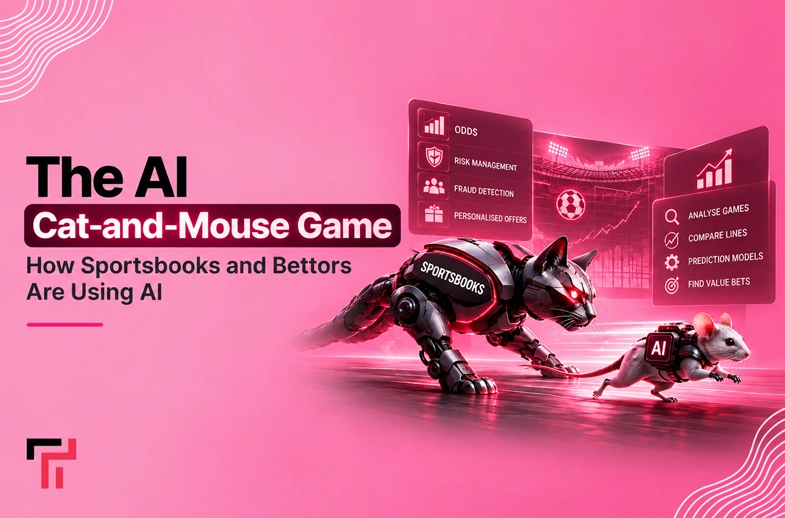
Sportsbooks and bettors are now using artificial intelligence against each other. Bookmakers rely on AI to calculate odds, manage risk, detect suspicious activity, and personalize offers. Bettors use similar technology to analyze games, compare lines, build prediction models, and look for potential pricing errors.
This has created a digital cat-and-mouse game driven by AI and predictive analytics. When bettors discover a useful pattern, sportsbooks adjust their models. When bookmakers improve their pricing, bettors search for better data or faster ways to interpret it.
This competition is particularly intense in live betting, where odds can change within seconds.
AI tools can improve research, but choosing the right betting platform still requires human judgment. Bettors should compare the best regulated and offshore sportsbooks by considering licensing, legal availability, withdrawal policies, betting limits, and consumer protections, not simply the odds being offered.
How Sportsbooks Use AI to Set Odds
Bookmakers have always used statistics to price sporting events. AI allows them to process a much larger volume of information and update their calculations more quickly.
Depending on the sport and market, a sportsbook’s system may analyze:
- Historical team and player performance
- Recent form and matchup history
- Injuries and expected lineups
- Weather and venue conditions
- Coaching decisions and tactical changes
- Betting volume on each outcome
- Movement across the wider betting market
The model uses this information to estimate how likely each outcome is. The sportsbook then builds its margin into the price before publishing the odds.
However, the opening line is only the beginning. Once customers start betting, bookmakers receive new information from the market. If an unusually large amount of money is placed on one side, the system may recommend adjusting the odds.
This does not necessarily mean the sportsbook believes that side will win. The adjustment may be intended to manage financial exposure, respond to new information, or keep the price competitive with other operators.
Why Live Betting Depends Heavily on AI
AI has become especially important in live or in-play betting. During a game, a single goal, injury, penalty, turnover, or change in possession can affect several markets at once.
Automated systems can process a live data feed and recalculate the probability of each outcome almost instantly. Updated odds may then appear before a human trading team can manually review every market.
For example, if a football team scores early, the system may immediately update:
- Match-winner odds
- Total-goals markets
- Correct-score prices
- Next-team-to-score odds
- Individual player markets
Human traders still play an important role. They may suspend a market when the live feed is delayed, review unexpected price movements, or intervene when the model lacks enough context.
Bettors are also trying to improve their reaction speed. Some use live statistics, automated alerts, and probability tools to find differences between what is happening in the game and the odds currently available.
A visible delay does not always create a genuine opportunity, though. The sportsbook may have access to a faster data feed, suspend the market before accepting the wager, or update the price while the bet is being submitted.
How AI Helps Sportsbooks Manage Risk
Setting odds is only one part of a sportsbook’s operation. AI can also examine account activity, payments, devices, and betting behavior for patterns that may require attention.
For example, a risk-detection system may identify:
- Several accounts are operating from the same device
- Unusual deposit and withdrawal activity
- Coordinated bets placed within a short period
- Attempts to misuse bonuses or promotions
- Sudden betting activity on an obscure market
- Account behavior that differs sharply from its history
An alert does not automatically prove wrongdoing. It gives the sportsbook’s risk or compliance team a reason to investigate the activity more closely.
AI-assisted monitoring can also support sports integrity. An unusual betting pattern may be reviewed alongside team news, market movement, and other information to determine whether further investigation is needed.
Once again, the technology identifies patterns rather than proving what caused them. Human investigators still need to interpret the evidence.
AI and Responsible Gambling Monitoring
Some sportsbooks use automated systems to look for changes in behavior that could indicate harmful gambling.
Some sportsbooks use automated systems to look for changes in behavior that could indicate harmful gambling. Research published by the Massachusetts Gaming Commission has examined how AI and player-behavior data can be used to identify potential risks of gambling-related harm.
Possible warning signs include:
- Deposits are becoming more frequent
- Stakes rising quickly
- Longer or late-night betting sessions
- Repeated attempts to recover recent losses
- Frequent changes to deposit limits
- Rapid movement between different betting markets
AI can help an operator recognize these changes earlier than a manual review might. The sportsbook can then display a warning, suggest a limit, restrict marketing messages, or ask a trained employee to review the account.
The value of this system depends on what happens after an alert is generated. Detecting risky behavior has limited benefit if the operator does not follow it with an appropriate action.
How Sportsbooks Personalize the Betting Experience
Sportsbooks can use recommendation technology in a similar way to streaming services and online stores.
If a customer regularly follows basketball and places totals bets, the app may display basketball games and over/under markets more prominently. A football bettor may see favorite leagues, teams, and player markets near the top of the homepage.
This personalization can make a large sportsbook easier to navigate. It can also be used to decide which notifications, promotions, or suggested bets a customer receives.
That creates a responsibility for the operator. Personalization should not target customers who have self-excluded, set strict limits, or shown signs of harmful behavior.
AI can help create a more relevant experience, but operators need safeguards to prevent the same technology from encouraging unhealthy betting habits.
How Bettors Use AI to Analyze Games
AI has made sports analysis more accessible to ordinary bettors. A person no longer needs to be an experienced programmer to organize data, test an idea, or build a basic prediction model.
Bettors may use AI to:
- Organize historical game data
- Compare player and team statistics
- Summarise injury and lineup reports
- Identify recurring performance patterns
- Estimate the probability of an outcome
- Test a strategy against past results
- Create alerts when certain conditions appear
A bettor may use a model to calculate the estimated probability of a team winning and then compare it with the probability implied by the available odds.
If the model estimates a 55% chance while the sportsbook’s price implies a 48% chance, the bettor may see potential value.
The challenge is determining whether that difference represents a genuine pricing opportunity or an inaccurate model.
Finding Patterns Does Not Guarantee Accurate Predictions
AI is good at finding patterns, but not every pattern is meaningful.
A model can produce misleading results when:
- The data sample is too small
- Important information is missing
- Historical data contains errors
- The model gives too much weight to recent results
- Past conditions do not match the current event
- The strategy has been overfitted to old results
Overfitting happens when a model performs extremely well on historical data but fails when tested on new games. Instead of learning a repeatable relationship, it has learned the quirks of the original dataset.
This is one reason a strategy that looks impressive in a backtest may perform poorly when real money is involved.
Sports also contain unpredictable events. An early injury, red card, refereeing decision, or sudden change in weather can affect a game in ways that historical data cannot fully anticipate.
Bettors Use AI to Shop for Better Lines
One of the most practical uses of betting technology is line shopping.
Different sportsbooks may offer slightly different prices on the same event. One operator may have a better point spread, while another offers a stronger moneyline or total.
AI-powered comparison tools can monitor several sportsbooks and alert bettors when a more favorable price becomes available.
These differences may appear small on an individual wager, but repeatedly accepting weaker odds can reduce long-term returns. Finding a better price does not guarantee that the bet will win; it simply improves the potential value of that particular wager.
Bettors must also confirm that the markets are genuinely equivalent. Two offers that look similar may have different settlement rules, limits, exclusions, or conditions.
Can Generative AI Help With Betting Research?
Generative AI tools can summarise reports, explain statistics, organize research, and help users create basic spreadsheets or code for data analysis.
For example, a bettor could use an AI assistant to:
- Explain how implied probability works
- Summarise several team-performance reports
- Create a checklist for analyzing a game
- Build a formula for comparing odds
- Identify missing variables in a prediction model
These tools can save time, but their answers should not be accepted without verification. A generative AI system may use outdated information, misunderstand a question, or confidently provide an incorrect statistic.
It is particularly risky to rely on AI for last-minute injuries, starting lineups, odds, or other information that changes quickly. These details should be confirmed through current and reliable sources before making a decision.
Why AI Cannot Guarantee Betting Profits
AI can process information faster than a person, but it cannot eliminate uncertainty or guarantee a profitable betting system.
Sportsbooks also use advanced data, experienced traders, and automated pricing models. When bettors identify a widely available advantage, bookmakers can adjust their odds or limits to reduce it.
Popular strategies can also lose their effectiveness. If many bettors use similar data and models, they may all target the same price. The resulting activity moves the line until the original opportunity becomes much smaller or disappears.
Most importantly, AI does not change the result of accepting poor odds. It cannot make chasing losses, increasing stakes impulsively, or betting without a budget sustainable.
The technology can support a disciplined process, but it cannot replace one.
Who Has the AI Advantage?
Sportsbooks currently have several structural advantages. They can access large volumes of betting data, professional trading teams, fast sports feeds, and models developed specifically for their markets.
Individual bettors have greater flexibility. They can specialize in a particular league, team, or type of market without needing to price thousands of events every day. A focused bettor may notice context that a broader automated system does not fully capture.
Neither advantage is permanent. When bettors find a repeatable weakness, bookmakers respond. When sportsbooks introduce more accurate models, bettors look for new information, markets, or methods.
That ongoing adjustment is what makes the relationship a cat-and-mouse game.
The Future of AI in Sports Betting
AI is likely to make sports betting faster, more personalized, and increasingly automated.
Sportsbooks will continue improving live pricing, customer-risk monitoring, fraud detection, and market management. Bettors will gain access to more capable research assistants, prediction tools, and real-time line comparisons.
As these tools become widely available, simply using AI will no longer provide an advantage. What will matter is the quality of the data, the assumptions behind the model, and the user’s ability to recognize when an output is unreliable.
AI can assist both sportsbooks and bettors, but it does not remove risk from gambling. The technology may change how decisions are made, while judgment, discipline, and responsible limits still determine how those decisions are applied.